By Kevin Young, Industry Consultant at Hexagon Safety & Infrastructure

Kevin Young-photoAs I travel across the country with Hexagon Safety & Infrastructure showcasing emergency management software at conferences and events, a reoccurring conversational theme is: “It needs to be something I use every day”. What these folks mean is if they aren’t using an emergency management solution on a daily basis, they certainly won’t turn to it during an emergency event; they will turn to the familiar, the understood, and the everyday tools they use to get the job done.

That makes sense. I won’t argue with that logic. The last thing you need is to waste time trying to figure out an emergency management application you haven’t touched in six months, or a year, or even longer when situations happen. My experience in emergency response planning has occurred largely within the energy sector, and largely within small to medium sized businesses. In general, the technology I’ve seen used to address an emergency response includes cell phones, conference bridges, and the occasional computer connected to a projector on a large screen in an emergency operations center. The infrastructure control systems (e.g., SCADA) also play a large role in the operational aspects of the response. But not so much in the coordination and management of the response. A quick search of the Internet will tell you that approximately 50 percent of organizations use some form of emergency management software to coordinate staff in a crisis. But when you talk to those organizations they tell you “yeah we bought that, but we don’t use it.” Why? The app is cumbersome, or there is a simpler, more common means to complete whatever task or process the emergency management software was purchased for. As a guy who works for an emergency management technology company, it’s definitely thought provoking.

There are a lot of emergency management tools out there, and a lot of thought and intelligence has gone into developing systems to improve response time, reduce impact, and save lives. I believe these technologies, used as designed, do improve the process of planning and responding to an emergency. And yet, by and large, the common tools continue to be used, and proclaimed as better simply because of their familiarity. So how do you get beyond the common? Or put another way, how do you make the improved systems, those with the intelligence and functionality to significantly improve the metrics of a response, the common tools that are used? You have to make the system and its interfaces useful every day, and you can help that by operationalizing emergency management.

Sound complicated? It’s not as complicated as it might seem, but it does involve a certain shift in organizational dynamics and culture. Really, what I’m talking about is setting up your emergency management software system(s) and processes so they are integrated with the daily activities of your organization. Each day is addressed as an event with the potential to include any number of emergencies. The emergency management system doesn’t need to interfere with daily operations, but it should be set up to absorb and take-in the results of daily operations at a higher level.

And, should some of those results be unexpected or outside normal parameters, the system and personnel are ready to address those instances as part of standard, common emergency management operations. Many emergency management systems come with a map, so it should always be kept up to date with ongoing activities and statuses. Other systems have communication interfaces, task tracking, and assignment – use them within the emergency management team – and within the larger organization – to process workflows. If the system performs resource management, use it daily to monitor the emergency management resources (and others) to know who’s on where and when. If the staff uses the tools daily, train other applicable staff through routine interaction, and there is a conscious level of readiness maintained across the organization, you’ve obtained emergency management nirvana. And, ideally, the more sophisticated and complex systems and tools designed to improve emergency planning and response will become the common ones used and looked to when a disruption to normal day-to-day operations occurs.

At Hexagon Safety & Infrastructure, we encounter organizations where emergency management systems have been installed to address emergency events, but lay dormant, unused, and likely unusable should an emergency happen. We understand organizations want value for their investment and that is why with each technological systems implementation we include transition and adaptation phases to help with the organizational culture shift. Emergency management software implementations are most successful when the idea that an emergency can occur at any time is actively embraced, and operational metrics associated with normal and abnormal activity are embedded in each process. As emergency managers, coordinators, and planners focus on responsibilities with attention to the systems in place to improve emergency management performance, the need to learn from and engaging these systems so that they become familiar and part of the common tools in use is essential.

We want to give emergency professionals and responders a chance to check out our technology and test how it could work for you and your organization. We will be hosting several Canadian Emergency Management Roadshows in Canada with a few stops in Ontario, so be sure to check the OAEM events page for more information.
By Paul Hassanally

For most of the month of June, 2016 I had the opportunity to deploy to Fort McMurray with an Non-Governmental Organisation (NGO) called Team Rubicon to help the Regional Municipality of Wood Buffalo (RMWB) facilitate the re-entry of evacuated residents. Team Rubicon unites the skills and experiences of military veterans with first responders to rapidly deploy emergency response teams. The global disaster relief organization offers veterans, first responders as well as emergency management professionals and eager civilians the opportunity to serve communities affected by disasters. Founded in 2010 by two American veterans, Team Rubicon currently counts 35,000 volunteers across country affiliates in the United States, the United Kingdom, Australia, and now Canada.

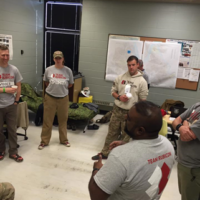
The Team Rubicon Command Post with the initial group of volunteers. As the operation scaled up, the Command Post was reconfigured four times to better suit the increased staffing, planning and workflow. Image Credit: David Korus, Team Rubicon USA

The Fort McMurray deployment was Team Rubicon’s first mission in Canada and marked the operational launch of its national affiliate: Team Rubicon Canada. With a more formal launch slated for later this year, for the last seven months, a team of Canadian veterans have worked alongside emergency management professionals such as myself to bring Team Rubicon’s model of disaster relief to Canada.

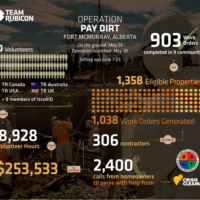
On May 25, 2016, a seven-person team of American and Canadian Team Rubicon volunteers arrived in Fort McMurray to set to work with the RMWB. With myself as the Incident Commander and the support of Team Rubicon Global, USA, UK, Australia and a partner NGO, IsraAID, Team Rubicon Canada’s operation in Fort McMurray would scale in a matter of three days from 25 to over 380 personnel, including local government employees, private contractors, volunteers and other partner volunteer groups. This rapid scaling was all made possible by the disciplined use and application of ICS by Team Rubicon.

The first task that the RMWB gave to Team Rubicon was to support the reopening of the local food bank by decontaminating non-perishable goods and disposing of any unusable food stock. Completed in three days, the volunteers then began to work on disposing of fridges that had become biohazardous after a month of being left with food products in them since before the evacuation.

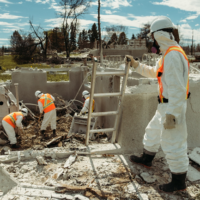
While fridge removal was underway, the Team Rubicon command team was busy planning the next large task, which was to design and implement a program with the RMWB to provide a service to sift through the ashes of burned homes to retrieve special heirlooms or personal items for residents. This was an especially complex task since the ashes of the homes were considered to be hazardous material under a protective coating that had been applied to the burned areas to keep the ash contained. These conditions would require all volunteers and workers in these areas to wear Level C hazardous materials personal protective equipment, which included Tyvek suits, rubber boots, gloves, half-face respirator, goggles and hard hats.

Strike Teams were led by Team Rubicon Volunteers and staffed by local contractors trained by Team Rubicon to work in Haz Mat Level C protection. Photo Credit: Jeremy Hinen, Team Rubicon USA

The coordination and planning tasks involved in implementing this program meant that Team Rubicon had to manage an inbound-outbound call service to residents scheduling service time windows, plan specific daily work plans for each of the site sifting teams, and track completions for reporting to the Regional Emergency Operations Centre (REOC) and ultimately, the Province of Alberta. All of this was done using ICS, with close coordination between Team Rubicon and the REOC’s planning and operations sections. The REOC and Team Rubicon anticipated that there would be popular demand for this program, so Team Rubicon Operations Section volunteers were used as strike team leaders for site sifting strike teams, augmenting each team with locally contracted labour to field a total of 44 strike teams with 6 personnel each. At peak output, this operations section was completing in excess of 90 property sifting work orders (averaging 3-4 hours each) per day. To achieve this level of impact, a three-day scale-up was conducted where incoming personnel were fit-tested for their masks, trained, and embedded onto a team for learning the sifting process, under close supervision of the Team Rubicon Safety Officer.

Towards the end of the Team Rubicon operation in Fort McMurray, the effort had scaled back down to 22 strike teams and the few remaining work orders were handed over to the RMWB, who inherited the ICS structure that Team Rubicon had put in place for this operation. The effective transition was achieved through a two-day “relief-in-place” procedure, where incoming personnel were embedded to shadow Team Rubicon on the first day, while on the second day Team Rubicon mentored the incoming personnel to provide advice as they completed their tasks within the established ICS structure. Furthermore, members of Team Rubicon’s planning and operations team kept thorough documentation, with daily Incident Action Plans (including mapping, media, and work completion reports), and provided all of these reports to the Regional Municipality of Wood Buffalo upon Team Rubicon’s demobilization.

An infographic summarizing the scale of sifting operations led by Team Rubicon in Fort McMurray, Alberta. Image Credit: Kirk Jackson, Team Rubicon, USA

Throughout Team Rubicon’s deployment to Fort McMurray, the disciplined use of ICS enabled an agile and scalable response in building, equipping, training, and managing an organisation of about 350 international volunteers, government and contracted responders in three days.

For more information about Team Rubicon Canada, find the official Facebook page at www.facebook.com/teamrubiconcan and keep an eye out for the launch of www.teamrubiconcan.org in the coming days!

For more information on Ontario’s IMS (compatible with ICS), visit www.ontario.ca/ims for free resources and courseware.

By Alain Normand, Manager, Brampton Emergency Management Office (BEMO)

You all know the story of the carrot and the stick. You use the carrot to encourage the donkey to pull the cart or you use the stick to force the donkey forward. Each option assumes that you have the proper tool, either a carrot or a stick.

A few weeks ago, CEMCs in Ontario received the annual form letter from the Chief of OFMEM reminding us that we needed to work towards being compliant to the Ontario legislation and regulations for emergency management. In 2015, apparently 32% of municipalities were non-compliant.

So now the province is trying to encourage municipalities to follow the regulations but they have no carrot to offer and they never had. There are no incentives for municipalities to be compliant to this legislation. The other option then would be to use a stick but the province doesn’t have a stick either. There is no enforcement and there are no penalties for not being compliant. You get a letter from OFMEM if you are compliant but nothing if you are not; big deal, right?

Actually, the professionals in the Ontario emergency management community have been telling the province for years that the legislation and the regulations are wrong. There are many inconsistencies, useless actions, and poorly defined requirements.

Take the critical infrastructure identification for example. If you base your definition of critical infrastructure on the sectors suggested, you need to include food as a critical need and all infrastructure related to food production and distribution should be on that list. All CEMCs should then have a list of all farmers, grocery stores, and other food-handling companies in the municipality. The list should contain emergency phone numbers for each and be maintained at least annually.  However, once we have the list, there is no indication of when we should use it and how. Since 99% of the critical infrastructure is in the hands of private entreprise, CEMCs have no power to enforce any kind of critical infrastructure protection. So why are we doing this?

Take public education as another example. The regulation says we have to do public education in our community. There is no clear definition of what public education should include. So having a web page with a couple of suggestions on personal preparedness could in principle be enough to fulfill the requirement.

On the other hand, when it comes to training, the requirements are very stringent with a list of course that must be taken by key people. These courses must be offered by EMO certified trainers and must follow the EMO curriculum to the letter. The fact that municipalities have very different structures especially when rural communities are compared to large urban ones, implies that the one size fits all approach of these courses does not work, yet all CEMCs must follow exactly the same training program.

There are also inconsistencies in the regulation when trying to apply the IMS model. The regulation talks about having a control group and suggest that members of the senior management of the community should be part of this group. However, looking at IMS, there is a big difference between the control group and the policy group. The first is composed of the leaders of each of the various teams within the IMS along with the EOC director, the PIO, and a few select advisors such as the solicitor. The policy group is where senior management should be sitting with a few other key players.

So being compliant is very much left up to interpretation. In my community, we have been providing scribe training for a number of years. We realized after a few exercises and a couple of real emergencies that trying to keep notes and logs while making decisions and coordinating action plans is nearly impossible. In decision-making positions, the priority is on taking action and giving instructions, not on log-keeping. So the logs and notes are often incomplete.  To remedy this, we created scribe positions in our EOC and ensured that designated scribes received the proper training. We brought in consultants to train on a one-day course with an exercise scenario and a mock inquiry. Currently we have about 40 staff members that have received this training. This approach frees up the CEMCs and other key decision-makers while still ensuring a high level of log-keeping and documentation.

The Elliot Lake Inquiry report addressed the issue of incomplete note-taking and recommended actions to ensure a higher level of note-taking for all emergency response and emergency management functions. In reaction to these recommendations, the province created a 10 slide course called note-taking. That course became mandatory without any consultation. When my community submitted that we did not require the note-taking course because we had a different approach as explained above, someone at OFMEM arbitrarily decided that our approach was unacceptable and included our community in the 32% of non-compliant communities.

So what? I believe my community is more than compliant because we have gone beyond the requirements of the regulations. Most of what the legislation and regulation demands in Ontario is actually very basic. Back in 2001, the plan was to bring in three levels of emergency management programs, an essential level, and enhanced level, and a comprehensive level. It would be up to the municipality to determine how much resources they were ready to commit to achieve the second and third levels while the first was going to be mandatory.  Fifteen years later, the province is still trying to get a grasp of what should be in the essential level. Fortunately a number of municipalities have gone beyond the essential and are actually implementing elements of what was considered for the other two levels. That’s called due diligence.

The good thing with due diligence is that there is no need for a carrot or a stick. When the donkey needs to eat, drink or get away from the heat, it will naturally move forward. Communities that voluntarily adopt enhanced or comprehensive emergency management programs, have no need for carrots or sticks.

My suggestion for 2016 is this. If instead of having 32% of municipalities in Ontario being on-compliant, we actually have all communities – that’s 100% – simply refuse to submit a compliance form. Maybe we will get a bit more attention from the Ministry. We can then ask the province to sit down with the CEMCs at a general meeting and agree to modify the regulation to fit accepted principles of emergency management rather than arbitrary and reactionary provisions. Instead of creating regulations that need all sorts of interpretation, let’s sit down as a profession and come up with a plan to make Ontario communities resilient without needing carrots or sticks.

By: Kevin Young, Industry Consultant at Hexagon Safety & Infrastructure

The Hexagon Safety & Infrastructure team recently attended the 2016 Ontario Association of Emergency Managers (OAEM) annual general conference and meeting.  Well done to all involved in the coordination and delivery of this event – the sessions were informative, the attendees engaged, and I am still mulling over many of the things I’d heard from and discussed with my industry peers.

One interesting item was the concern voiced by some that emergency managers struggle to obtain the resources and support required by their department. This in and of itself is not uncommon (to managers in general), but speaking as someone who has worked in the industry both in a consulting and full-time staff role, I can say that for emergency management, this struggle is sometimes based more on a waning sense of importance, rather than a true lack of capital. Both in business and government, there can be a marginalizing of the office and discipline of emergency management; a hinting attitude that the emergency preparedness mandate is somewhat overzealous and not connected to the reality of operations, as we all naturally become complacent over the sometimes long periods between major emergencies. Of course, events occur that highlight the value and need for emergency planning and response, like the Fort McMurray Fire, which renews the sense of appreciation for the emergency manager / coordinator / planner and the realm of their activity. How do we maintain this?

I’d like to suggest technology can help. Emergency management information systems, planning and response applications specifically, when implemented and maintained correctly, draw in the ideas and opinions from personnel spanning the spectrum of the organization’s activities, which helps to build a common sense of value.  In general, collaboration between persons, departments, and agencies is difficult. Interestingly however, everyone generally agrees more collaboration is better, particularly in the area of emergency preparedness. As more collaboration is better and collaboration is essential to emergency preparedness, emergency managers can work to cultivate and propagate a collaborative environment as they execute their responsibilities. Well-designed emergency management software, as a tool for the emergency manager, can be an effective conduit and means to facilitate this collaboration and demonstrate the common worth of being prepared.

The emergency manager / coordinator / planner holds a unique position within the organization in that part of their role is to broker the requirements of the various areas into a common plan for success… should an emergency occur. Done well, using the right tools, this can lead to an ongoing mutually respectful relationship with representatives from each of the areas of the organization.  There may not always be unwavering support, but an emergency response platform utilizing effective technology to streamline, bolster, and improve the process of emergency preparedness can have a significant impact on the ongoing support for the emergency manager and their sphere of influence during the extended periods of normal operations, as well as when things go sideways fast.

We (Hexagon Safety & Infrastructure) have seen in numerous instances around the world where technology has improved the processes of emergency response planning, largely because we are invested in the task of developing tools to assist organizations in this regard and shape the evolution of emergency management.  We know technology is only one piece of the puzzle, but we hope the above notes cause you to consider how technology can enhance your processes from a more relational perspective, how, when applied tactfully, technology can “shape smart change” for you and your organization.  If you have any questions regarding technology and emergency management, feel free to email me at kevin.young@hexagonsi.com. If you’re looking to see how others around the world are using technology during planned and unplanned events, check out our post “Europa League Finals in Basel: Planning and Response Technology on the Frontline”.


THE NEW DATA

By Sarah Kirkwood, Emergency Management Consultant, GHD

Following the Lac Megantic train derailment, PD 32 was implemented in response to concerns raised by municipalities regarding the unknown types of dangerous goods transiting through their backyards. This lack information was cited as a gap for Emergency Planning officials conducting complete HIRAs by municipal staff and politicians, ultimately compromising municipal readiness to protect against emergencies involving hazardous materials. PD 32 required Class 1 and Short Line Railways to provide registered Municipal Emergency Planning officials with information on products shipped through their communities.

Though PD 32 broke new legislative ground, it was criticized by the emergency management community as providing unusable and outdated (year old) data to Planning Officials with many job demands. PD 36 has been issued to address these concerns and includes specific requirements on data timeliness, format and aggregation as well as the provision of data in either French or English based on the registrants desired language of communication.

Specifically, item 5 of the Protective Direction requires that data be provided in a usable format, outlining a prescriptive excel spreadsheet column listing requirements that is anticipated to assist in data analysis for municipalities making emergency planning decisions.

It is important to note that this information is provided only to registered municipalities and only to the registered Emergency Planning Official. To register or update municipal information an email may be sent to canutec@tc.gc.ca with current contact information.

BUT NOW WHAT?

As asked by the Deputy Minister of Community Safety and Correctional Services Matthew Torigian at the recent OAEM conference, “What would you do with the data if you had it?”

Mr. Torigan touched only briefly on the issue of data being only one step in a long process. It is possible that the information may lead to the modification of municipal HIRAs or looking for increased hazardous materials capabilities, though this process may not be something all municipalities can perform in-house.

The question posed by Mr. Torigan is not a simple one. Data provided by PD 36 represents only the presence of possible hazards and should not be considered a true measure of risk. The provision of information to municipalities is a good first step that will allow for a more effective assessment of municipal hazardous materials response capabilities from rail; however, the data provided from PD 36 would also need to be considered in other areas of emergency management including, but not limited to; existing Emergency Response Assistance Plans (ERAPs), Rail Response Plans, the location and agreements with existing hazardous materials contractors, existing or possible mutual aid with other municipalities or identified companies, and the ever present question of available budget to spend on changes in response. And on top of that large list of considerations is the possibility that no change is needed.

Only when examined in context with a full risk landscape, and compared with possible municipal solutions and other evaluated risks (such as flooding or storm events), may planning officials perform the proper risk assessments to make informed recommendations to council. Though the risk evaluation may require external resources, the prioritization and specific solutions must be determined in house as possible changes in readiness need to be tailored to each municipality. Solutions must be sustainable, appropriate and effective in the specific context of the location, risk tolerance and resources of that municipality.

Stay tuned for more articles on ERAPs, contractors, mutual aid, rail hazards and how they contribute to the risk climate within a municipality.

Full text of the protective direction may be found on Transport Canada’s website through the following link: http://www.tc.gc.ca/eng/tdg/safety-menu-1281.html

It has been a fairly active period weather-wise recently and that has kept me from posting another blog. In the last month in Ontario, we have seen snow, ice pellets, freezing rain and rain. March started off like a lion with a notable winter storm. That was followed by the first tornado of the season occurring west of Mount Forest on March 16 then an ice storm for parts of southcentral Ontario on the 24th. Then the month ended with a significant rain event.

The first part of April has seen the return of the Polar Vortex with temperatures dropping to well below seasonal values along with an unwelcome extension of the snow season for many in Ontario. A return to more seasonal weather is expected around mid-month with the more seasonal weather likely lasting well into May.

As we start to bid goodbye to the cold in the coming weeks, thoughts will turn to the possibility of thunderstorm activity. The severe thunderstorm season in Ontario usually runs from late April until early October. Severe thunderstorms are capable of producing damaging winds, large hail, flooding rains and tornadoes. As was noted above, we have already had our first tornado of the season back on March 16th. This was the earliest occurrence of a tornado ever in Ontario beating the previous event that occurred on March 19th, 1948 in the Windsor area.
canwarn logo
Even with all of the latest technology at their disposal, forecasters in the Ontario Storm Prediction Centre in Toronto still rely on credible, on-the-ground reports from trained storm spotters involved in the CANWARN program. A series of training sessions will again be held this spring across the Province to refresh the training of returning volunteers and to introduce new volunteers to the program.

The training is about 2.5 hours in length and there is no cost to attend. The following is a list of existing training sessions, more will be added in the Northwest in the coming weeks (likely to take place during the week of June 13th) and any OAEM member would be welcome to attend a session that is convenient for them.

To RSVP for a given session or for more information on the program, feel free to drop me a note at geoff.coulson@canada.ca.

April 15 – Wellington County: 9 AM – Aboyne Hall, Wellington County Museum, 536 Wellington Road 18, Fergus

April 20 – Central Huron/Blyth: 7 PM – Emergency Services Training Centre – 40193 Blyth Road, Central Huron/Blyth

April 23 – Hamilton: 9 AM – Stoney Creek City Hall – 777 Highway 8, Stoney Creek

April 25 – Leamington:  7 PM – Leamington Kinsmen Recreation Complex – 249 Sherk St, Leamington

April 27 – Sarnia: 7 PM – Sarnia Yacht Club – 1120 Fort St, Sarnia

April 28 – London: 7 PM – Fanshawe College, 1001 Fanshawe College Blvd, Building T, Room T1003

May 3 – Dufferin County: 7 PM – Dufferin County Courthouse, 55 Zina Street, Orangeville

May 3 – Kingston: 6:30 PM – Artillery Park Aquatic Centre, Multi-purpose room, 382 Bagot St

May 4 – Waterloo:  7 PM – Venue to be determined

May 7 – Toronto :9 AM – Environment and Climate Change Canada Headquarters, 4905 Dufferin St., Toronto

May 10 – Toronto: 7 PM – Environment and Climate Change Canada Headquarters, 4905  Dufferin St., Toronto

May 10 – Ottawa: 6:30 PM – venue to be determined

May 14 – Rama/Orillia: 9 AM – Rama Fire Hall, 7454 Williams Road, Rama

May 18 – Niagara Region: 7 PM – Niagara Region Headquarters, Campbell East Room 102, 1815 Sir Isaac Brock Way (Formerly 2201 St. David’s Rd), Thorold

May 19 – Peterborough: 7 PM – Peterborough Lawn Bowling Club, 577 McDonnel St., Peterborough

May 24 – Mississauga: 9:30 AM – Noel Ryan Theatre, Central Library, 301 Burnhamthorpe Rd. W, Mississauga

May 25 – Markham: 7 PM – Cornell Community Centre Library Program Room, 3201 Bur Oak Avenue, Markham – parking tickets will be validated at the venue

May 28 – Belleville:  9:30 AM – Belleville Public Library, 254 Pinnacle St., Belleville

May 30 – Sudbury/Azilda: 6:30 PM – Lionel E. Lalonde Centre, 239 Montee Principale, Azilda

May 31 – Sault Ste Marie:  6:30 PM – 99 Foster Drive, Russ Ramsay Room

June 1 – Manitouwadge: 6:30 PM – Municipal Council Chambers – Manitouwadge

Now is your chance OAEM members—who do you want to represent your community and your needs on the OAEM board?

The upcoming 16th annual general meeting and conference will not only host a wide range of speakers and social events, but will also give new board candidates an opportunity to introduce themselves to the emergency community whose needs they hope to represent for 2016-2018.

If you are interested in running, please contact the OAEM Election Coordinator at secretary@oaem.ca. Voting will take place on May 13 at the AGM.

Candidate profiles to date:

Tim Lindsay, Emergency Management Coordinator, The Regional Municipality of Halton:

TimLindsayTim is a graduate of the Fleming College Post Graduate Program in Emergency Management and has completed numerous Emergency Management courses through OFMEM, JIBC and the Canadian Emergency Management College. In addition to being on the current OAEM Board, Tim is also a member of the Fleming College Emergency Management Program Advisory Committee.


Mike O’Brien, CEMC Burlington:
mikeobrienI am the CEMC for the City of Burlington. I have served on the OAEM board for the last two years as the Education Chair and the Vice President. During my time on the board I have increased the association’s online profile including the new OAEM website and social media sites. I have worked to foster ties with other DEM associations and student groups and helped develop joint professional development ventures with RCO. I would like to continue growing the association and the profession.


Nicole Pinto, Emergency Assistant, City of Vaughan:

Nicole PintoI am an emergency management professional and candidate for a Master of Arts in Disaster and Emergency Management at Royal Roads University. I am most experienced in community and health emergency management, and am currently the Emergency Assistant for the City of Vaughan. My previous roles have been in the capacity of emergency management with the City of Burlington and the Central Community Care Access Centre. I have been working on the OAEM Board for the past two years as the Student Board Member and Education Committee President. I have assisted with the development of the OAEM student mentorship program in order to create a greater student presence within the organization. My goal, as an OAEM Board Member, is to continue to build on the past work of the Board to create a well-connected network of professionals who actively participate in and benefit from OAEM initiatives.


Sarah Thompson, Emergency Management Research Analyst, City of Toronto: Sarah Thompson2After spending six years as an Emergency Social Services (ESS) responder, leading program implementation, IMS use in the field, and volunteer training, I took my passion for Emergency Management to academia. With my York University’s Master of Disaster and Emergency Management now complete, I am ready to help strengthen connections within and beyond the traditional EM community. To my relatively new home of Ontario, I bring a wide spectrum of knowledge from across Canadian EM programs, community groups and non-profits. Pair this with my formal education, and genuine passion for engagement and innovation in EM, and I believe I could be a dynamic and engaging presence on the OAEM board. If elected, I’d bring a new lens to OAEM’s main objective; to further the profession. I believe we can approach this goal though improved engagement; connecting and furthering the interests of EM professionals across industries.


Please note a change has been made with the voting process this year: Members attending the Friday afternoon meeting are allowed to bring 2 proxy votes only. These votes must only be for the members that have advised the Board in advance that they intend to run in the election at that meeting; for those who are nominated on the floor, proxy votes shall not be used for them. If you require a proxy vote form, please contact secretary@oaem.ca or download it here: OAEM AGM 2016 Proxy Form.


Have your say:

http://www.crtc.gc.ca/eng/archive/2016/2016-115.htm

As a reminder, the Canadian Radio-Television and Telecommunications Commission (CRTC) has proceeded with Public Consultation and you have until May 30, 2016, to submit your comments about Wireless Service Providers participation in Wireless Public Alerting. Your involvement and engagement will make a difference and help shape an effective National Wireless Public Alerting direction.

Action plan:

  1. We have recently received inquiries for specific support on how to submit comments as well as articles that may assist you in spreading the word out to your stakeholders and communities. We’ve also had a great idea from a supporter on engaging the public during Emergency Preparedness Week. To help facilitate, we have developed a webpage to house specific documents, articles, “how to’s”, FAQs and other pertinent information that may be useful for you to share.  http://www.canadianwpa.com  If you like, feel free to cut and paste onto your letterhead, use your own logos or brand as desired by replacing the Bruce Power branding.
  2. To help us track support, please reply and let us know if you are planning to submit a letter. Comments and/or letters (interventions) can be submitted on behalf of your government, agency, association, communication organizations, or you as an individual member of the public explaining why the implementation of Wireless Public Alerting (WPA) for all Canadians without delay and on all devices is of the utmost importance.  Real stories showing how cellular public alerting would have been helpful during disaster, crisis, evacuations would be most effective in your submission. Remember: Deadline for submission is May 30, 2016.
  3. Bruce Power remains actively engaged and will be submitting an intervention letter. We continue our communications to engage and urge others to do the same.

Social Media:

Bloggers, tweeters, and other Social Media Participants:  We need your help in educating the public on this issue.  If you are actively communicating about these issues in social media forms, keep @FutureShield_CW or @dpmcar informed and we will work together to get the message out – #alert2public and #talkalerting  The following blog site has snippets of current information that you and your public may find useful: http://riskcanada.wordpress.com

Key Message:

Our key message has, and always will be, the urgency and need to reduce the Time at Risk for Canadians and implement an effective Wireless Public Alerting System now that works on all handsets (current flip phones and smart phones – with no need to buy a new phone!) and all networks (2G, 3G, and LTE). Canadians, and the First Responders that serve to protect them deserve better; especially so, when there is technology available today (LB-SMS Text), already tested in 2014 that works on all handsets and networks today.

Recently our researchers have determined if Canada continues down the current path of Cell Broadcast, it will be 2025 before 49 per cent penetration to the public is realized as a result of the requirement to change out all handsets across Canada.

If you have questions or need any other support please feel free to reach out at any time.

Best Regards,

Dan McArthur Senior Strategist Nuclear Oversight and Regulatory Affairs Bruce Power Inc. Phone: (519) 361-7041 Cell: (519) 386-0698 Email: dan.mcarthur@brucepower.com Website: www.brucepower.com Cynthia Weeden Founder and President FutureShield (on contract to Bruce Power) Phone: (866) 675-7835 Cell: (416) 894-7362 Email: cweeden@futureshield.com Website: www.futureshield.com

Tuesday Oct 4th – Wednesday Oct 5th, 2016 | Sheraton Toronto Airport

 The Registrations for the Summit on Emergency and Disaster Planning for Colleges, Universities and K-12 Schools are now OPEN! The Agenda has just been announced and your complimentary copy of this year’s program is now available for download!


GET YOUR COPY OF THE PROGRAM NOW!


Learn Key Insights From:


Reasons to Attend


·         The largest gathering of emergency experts for educational institutions in Canada

·         Firsthand insights to strengthen school safety

·         Relevant updates for your planning, training and preparedness

·         Highly interactive sessions to build on school safety best practices

·         In-depth and specialized workshops for all types of educational institutions

Get $250 Off with this Pre-Print Offer Ending April 29th, 2016. Register Today with VIP Code: EDP250

To register, request updates, or ask a question on this year’s program:
CALL: (866) 298-9343

© 2025 ˈE-nē Org International Organization of Sample Groups, Website by Vieth Consulting

P.O. Box 23456
Sample Address Rd,
Sampleton ZD 23400

Ph. 555-555-1234
Fx. 555-555-4321